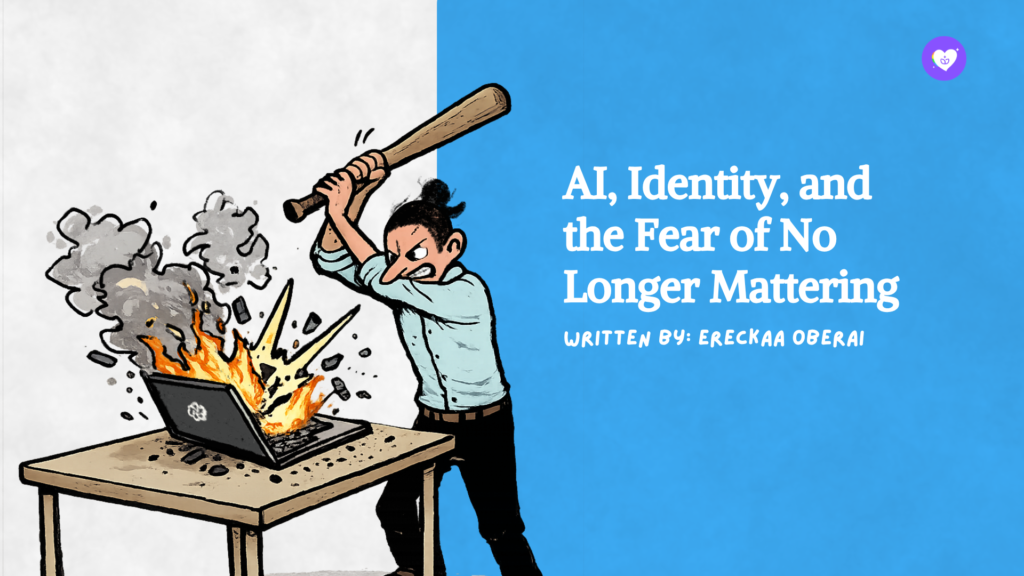

Stress Awareness Month: The Existential Weight of AI
April was Stress Awareness Month. And while we often talk about stress in familiar terms like deadlines, workloads, the relentless pace of modern life, there’s a form of stress that’s harder to name. It doesn’t announce itself with panic attacks or sleepless nights. It sits underneath everything, a low hum of unease that never quite goes away.
It’s the stress of living through change you didn’t ask for and can’t control. Of watching the rules shift faster than you can learn them. Of wondering if the skills you’ve spent years building still mean anything at all.
This isn’t the stress of doing too much. It’s the stress of not knowing if what you’re doing matters anymore. And increasingly, that stress is tied to something we interact with every single day: AI.
AI has become inseparable from how we work, create, and communicate. For many, it’s a tool that makes life easier. But for just as many, it’s become a source of profound psychological strain. Not because the technology itself is harmful, but because of what it’s quietly dismantling: the systems we built our identities around.
For most of human history, your skills gave you identity. Your expertise gave you worth. Your labor gave you purpose. AI has unraveled that. And the stress people are feeling isn’t just about employment. It’s about mattering
The Collapse of Competence
You spend years becoming good at something. Mastering a craft. Building expertise. Maybe you went to school for it. Maybe you learned on the job. Either way, you put in the time. You got good. Now a tool can do it in seconds. Better. Cheaper. Faster.
Slowly a question starts becoming concrete. The question becomes: if anyone can produce what I produce, what makes me valuable?
It isn’t just job insecurity. It’s identity collapse. Your competence and the thing you built your sense of self around suddenly feels worthless. And that creates a kind of stress that goes beyond financial anxiety. It cuts at something existential. We’ve built our entire lives around the idea that expertise protects you, that mastery has value, that getting good at something means something. AI challenges all of that at once. And when the foundation you’ve built on starts to crack, the ground beneath you doesn’t feel stable anymore.
The Exhaustion of Perpetual Becoming
You can’t ever “arrive” anymore.
Every skill you learn is already being optimized by AI. Every milestone loses meaning because the benchmark keeps shifting. You’re told to “keep learning,” “stay adaptable,” “embrace change.” But adaptation without rest is just chronic instability.
Being in constant flux, never being allowed to feel competent, never allowed to rest in what you know, is psychologically devastating. We, as humans, aren’t built for perpetual uncertainty. We look for stability. We need to feel like we know what we’re doing, even for a little while. When that gets stripped away, when you’re always becoming and never being, the nervous system doesn’t get to settle. You’re in a constant state of alert. And that’s not just tiring but also
unsustainable.
The Loss of Legibility
Humans need to understand the systems they live in. We need cause and effect. Input and outcome. We need to know that if we do X, Y will follow. That’s how we make sense of the world. That’s how we plan. That’s how we feel in control.
AI breaks that.
Decisions get made by algorithms you can’t see. Your work gets evaluated by metrics you don’t control. Success and failure start to feel arbitrary. You can’t “work harder” or “be smarter” your way out of opacity.
The stress isn’t just uncertainty. It’s illegibility. You don’t know the rules anymore. And when you don’t know the rules, everything feels uncontrollable. You can’t strategise. You can’t optimise.You can’t even tell if what you’re doing matters anymore. That kind of disorientation creates a specific anxiety where the problem isn’t that you’re failing, but that you can’t even tell what success looks like anymore
Grief for Futures That Were Promised
You were told: work hard, get educated, build expertise, and you’ll have security.
That contract now stands broken.
And it’s not just disappointment. It’s grief. Grief for the life you planned. The career path that made sense. The version of yourself you were becoming. AI has dismantled our belief systems about how the world works. And acknowledging that loss
We talk about technological advancement like it’s neutral, like it’s just progress. But for the people living through it, it’s not neutral. It’s the ground falling out from under you. It’s watching the future you were building disappear.
And grief needs space. It needs acknowledgment. It needs time to process. But instead, we’re told to adapt. To pivot. To see it as an opportunity. And that dismissal of what’s actually being lost, makes the grief harder to hold.
The Loneliness of Displacement
When an entire system shifts this fast, everyone’s scrambling alone.
You can’t find mentors because they don’t know the new landscape either. You can’t find peers because everyone’s protecting what little stable and known ground they have left. You’re supposed to “network” and “collaborate,” but the atmosphere is scarcity. Competition. Survival.
The isolation isn’t just practical. It’s existential. You’re navigating a world that does not have a map anymore. And that’s terrifying.
In past transformations, there were people ahead of you who’d figured it out. There were established paths through the change. But with AI, the pace is so fast that no one’s ahead. Everyone’s fumbling. And that collective disorientation, instead of creating solidarity, often creates more isolation. Because when everyone’s uncertain, vulnerability feels dangerous. So people pretend they’re fine. They perform with confidence. And the loneliness deepens.
Why “Just Adapt” Is Gaslighting
Adaptation requires time. Psychological safety. Resources. Support.
AI is moving faster than human nervous systems can process. Expecting people to “embrace change” without acknowledging the grief, the fear, the disorientation is of no help. Its bypassing.
You’re not failing to adapt. You’re grieving. You’re overwhelmed. You’re trying to orient yourself in a landscape that won’t stay still. That’s not a personal failing. It’s a structural reality.
When people say “just adapt,” what they’re really saying is: “your distress is inconvenient to me.” Because acknowledging how hard this actually is would require slowing down. It would require admitting that maybe we’re moving too fast. That maybe progress at this pace has real human costs. And systems don’t want to admit that. So they put the burden on individuals. They make it about resilience and mindset and adaptability.
But you can’t pave your way out of a systemic upheaval. You can’t mindset your way out of a continuously collapsing sense of purpose.
What This Actually Requires
What people need right now isn’t another workshop on “thriving in change.”
They seek permission to grieve what’s being lost without being told they’re “resisting progress.” Spaces that hold the fear, the disorientation and the anger. Not spaces that try to fix it or reframe it as an opportunity. Recognition that your worth isn’t tied to your economic usefulness or your ability to “stay relevant.” Systems that actually protect people during transitions, not platitudes about resilience. And the acknowledgment that this is hard. And it’s okay to not be okay with it.
We need to stop treating AI anxiety as irrational or as something to be managed away. It’s a sane response to a world that’s changing faster than humans were built to handle.
You’re not failing to adapt. You’re grieving. You’re disoriented. You’re trying to find footing on ground that keeps shifting.
And that deserves space. Not pressure to “keep up.” Not shame for struggling. Just space. To feel what you’re feeling. To name what’s being lost. To sit with the uncertainty without having to perform optimism about it.