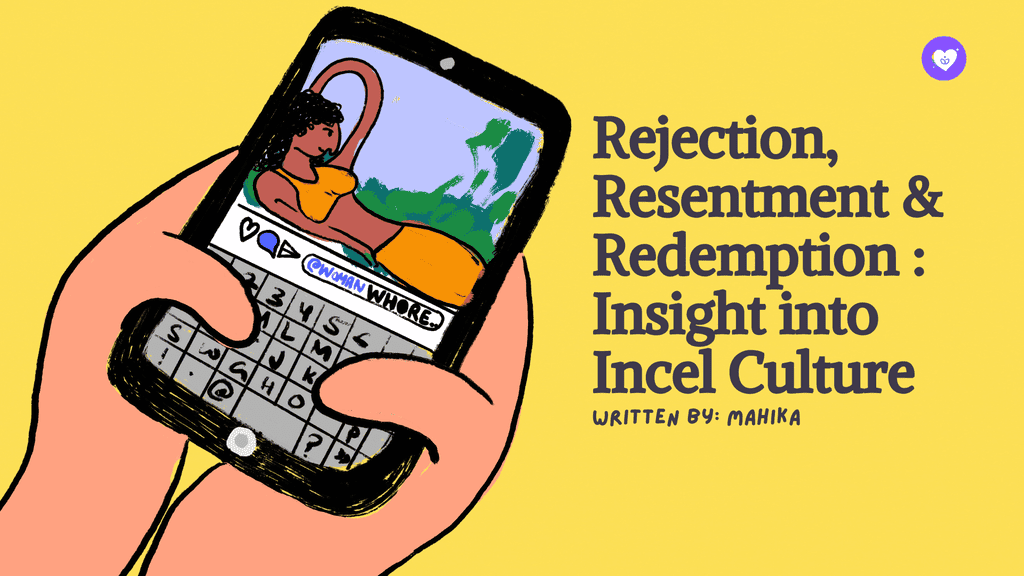

There is a particular kind of loneliness that simmers under the surface in many young people’s lives, a feeling of being unwanted, invisible and perpetually left behind in the world of dating. It is the ache of being perceived as a failure, of watching others experience affection, intimacy or companionship while you remain stuck in the loop of rejection. The pressure to have something going on always – be it a relationship, casual sex or situationship, has been tied with being young, masculine and desirable.
Some people find solace & understanding in the community. But for others, it festers into something dangerous, that is finding refuge in incel culture (involuntary celibate). To be clear, the pain is real and valid. Sense of shame, isolation & being shunned out in a world that is hypercompetitive & hyper-sexual, is not an imagined concern. However, the ideology around it is rooted in resentment, misogyny & entitlement is neither a solution or a salve.
Incel ideology flips the script, men, even those who benefit from patriarchy are the real victims. Victims of feminism and modern women, that does not guarantee them a partner in exchange for doing the bare minimum. These narratives degrade & dehumanize both men and women and reduce them to relationship and social hierarchies based on looks.
History
The term involuntary celibate, or incel, was first coined in 1997 by a Canadian university student named Alana, who created a website to document her difficulties in finding romantic connection. Initially, the platform served as a safe, inclusive space, welcoming people of all genders and orientations who were struggling with loneliness and intimacy. However, the site rapidly morphed into something else entirely, a male-dominated community, where sexual frustration was externalized and blamed solely on women who “refused” them.
Core of Incel Ideology
Incel ideology, at its core, is based on an appearance-based hierarchy, a belief that the society is rigged in favor of the attractive (especially conventionally good-looking men, aka The Chads). The average men, dubbed as Betas, are seen as unmatched in the dating pool and for incels, they remain at the bottom of the rung, undesired and unwanted. Women or Stacys, are painted as shallow, manipulative and hypergamous, basically seeking people out above them in hierarchy.
This view reduced connection to a game of aesthetics & dominance. It tells men that they are owed affection and sexual intimacy and when they don’t receive it, it is women’s fault. The incels, hence, turn to resentment and hatred. Many incels consume “Red Pill” content, which claims to expose the truth about the nature of females, while simultaneously criticizing westernisation & feminism for shifting their gender role.
Old system, New Rage
In India, incel ideology found fertile breeding grounds, due to existing patriarchal & hierarchial systems. In online Indian spaces, especially young men, incel rhetoric has merged with casteism, colorism, and class-based resentment.
Marriage, in India, is still seen as the only socially acceptable for sexual and romantic expression. Men, who are rejected due to caste, class, color – begin to internalize that rejection as a proof of injustice rather than seeing the broader structural inequalities at play. They turn to online forums like Reddit, Telegram and Twitter, consuming content from figures like Andrew Tate, whose definition of masculinity reinforces toxic power dynamics. Bollywood’s recurring image of the hero getting the girl – often through persistent, dominant and emotional instability also in a way, propagates the same dynamic.
Kabir Singh (2019) is a clear example of a film that glorifies emotional abuse, stalking, entitlement repackaged as love. Such portrayals echo the incel script that “you are allowed to act out because love hurts, because men are men and because she is yours eventually.”
Mental health – The Missing Link
What often goes unspoken in conversation about Incel culture is the mental health crisis at core. Loneliness, anxiety, low self-esteem, depression and other mental health conditions, factor why young people, especially men, turn to these ideologies in search of meaning and validation. But instead of finding care, they find communities that offer scapegoats.
The tragedy here isn’t just in the few who turn violent. It’s men who do not, but still carry these beliefs into future relationships, where dominance, resentment, and control become normalized. Incel beliefs don’t disappear, but they simply morph into jealousy, into entitlement and into abuse.
All in all, I think it is essential to hold space for pain without feeding it poison. Masculinity should be redefined that allows space for emotional vulnerability, rejection and respect. Talking about incel culture is not vilifying loneliness or mocking desire. It’s about asking: How can we offer something more relieving than hate?
And how do we create a culture where love isn’t dictated by social hierarchies, and rejection doesn’t always warrant a personal flaw?